🔮 Which Faction should you join when our Kickstarter goes live?
Take the Quiz
First, let me state that GAMA Expo was a con experience like no other. I’ve been to a lot of cons over the past decade as a consumer, a tournament player, and as a volunteer/employee behind the booth and running demos. GAMA Expo is for the industry, by the industry.
Every person you see or meet is in some way connected to this living ecosystem that we call gaming. You’ve got store owners/employees, content creators, designers, developers, publishers, manufacturers, distributors, lawyers, teachers, and more subgroups I probably don’t even know about.
The initial idea for this blog post was that I would write about the top five things I learned at the many seminars I attended at GAMA Expo, and I took a lot of notes. While some of these are directly seminar-related, a lot of them were resonating messages and general vibes that I got from the experience. Not only will I share my top five takeaways, but I’m going to give you some practical advice about how to implement them if you’re an aspiring game designer.
I’ve been an aspiring designer for over a decade now and have been on the outskirts of this world for a long time. It’s in that orbit where designers are trying to break in and make a name for themselves that I sometimes heard:
“If you don’t have connections you can’t make it big.”
It’s true, to a point, that it is who you know. The sentiment is just not coming from the right place.
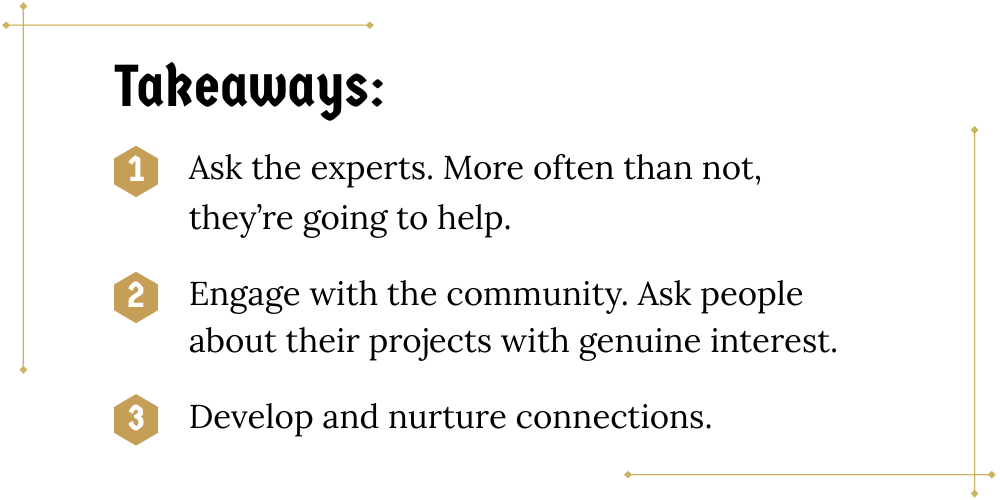
GAMA Expo made me realize that people in this industry are just so helpful. They are either learning just like you, eager to swap ideas and tips on how to get better, or they are industry veterans that have forgotten more than you know and want to help you not make the mistakes they did.
It can be intimidating, but I learned that you can and should approach each new person with an open mind and a smile on your face. Ask to learn about someone’s new project, or demo their prototype. Introduce yourself to the person sitting next to you in the seminar and learn something about them before the talk starts.
You can meet people at all stages of their career, and in all facets of the field. You can exchange ideas, stories, and laughs. Build connections that can lead to new opportunities that you could never have planned for. Those connections will organically build you up into a better designer, or whatever field you are in. That’s how you make it big, by being big, with each other.
I came into GAMA Expo wanting to write a blog post about the top five things I learned in seminars. I walked away knowing that my number one had to be something that wasn’t explicitly the topic of any seminar I took.
Not your company. Not your game. You.
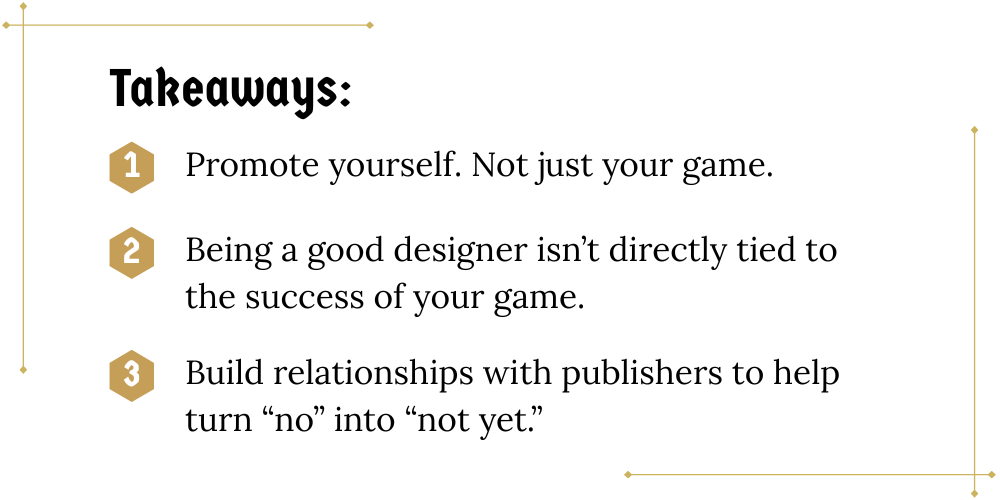
Rolling off of the sentiment of meeting amazing individuals, you should aim to be one as well. The project you are working on does not define you. Neither does the company you work for. You are so much more wonderful and complex than any one thing.
With that in mind, you shouldn’t make your marketing efforts be solely about promoting your company or game. It should be about promoting you, and I mean that in a more abstract way. By promoting the best things about yourself to the forefront, it will naturally market you to the world around you.
You should engage in the community as yourself, genuinely. As long as you are authentically providing value, you don’t have to be a master at what you are providing. Volunteer, fill that niche that speaks to you. Put yourself out there. People don’t know you until you introduce yourself.
Again for those in the back: You are not your game. So it shouldn’t be all you talk/post about, and you shouldn’t tie your self worth to its success. If the game fails, that does not mean you are a failure. You can be an amazing designer and still make a game that doesn’t resonate with people.
When pitching your game to publishers, sell yourself and build a connection. You are not selling a prototype, you are selling a partnership. Even if they say no to this game, get them to say yes to you. “If you didn’t like this, what are you looking for?” Change “no’s” to “not yet’s.”
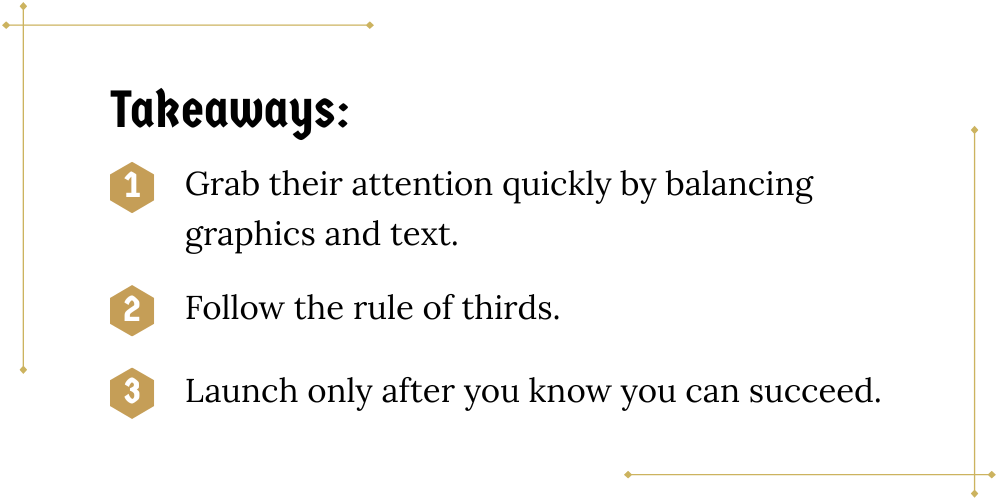
Gone are the days where you could just take a prototype of an idea with a few pictures, slap 'em on Kickstarter and get funded. There was a time where there were only a handful of games on Kickstarter at any given time. Now there are a dozen games launched every day.
You have to account for the fact that you are not launching into a vacuum. You have competition and only have so much time to grab and hold people’s attention. So you need to get to the brass tacks as quickly as possible by implementing these tips:
When designing your campaign, follow the rule of thirds. Your product should be 33% intuitive, 33% improved, 33% different. Show them why they can already relate to your product. Tell them how your product improved previous things in the genre. Then throw in your personal touch of what new things you've brought to the table.
There’s a lot to unpack in that one sentence. Let’s talk some basic numbers.
You really, really want to fund in the first 24 hours. Don’t expect your crowdfunding platform to help with that part. Imagine you are in a sea of campaigns. How can you possibly expect your platform to amplify every single campaign without making the amplification meaningless? So that first 100% funding needs to be your followers.
Only about 10-20% of the people that follow you on Kickstarter will back in the first 24 hours. So whenever possible, hold off on hitting that launch button until your follower count reaches 10x your expected goal.
I want to reinforce, these are specifically your followers on Kickstarter and not social media or in your community or email list. These are the people that are getting a notification directly into their inbox when your campaign goes live. The people that have already said “I want to know when I can give you my money.”
That being said, it’s still very good to have a stocked email list, vibrant social media presence, and a community that is spreading your good word. Just try to funnel them to that crowdfunding follow button as soon as your pre-launch page is live.
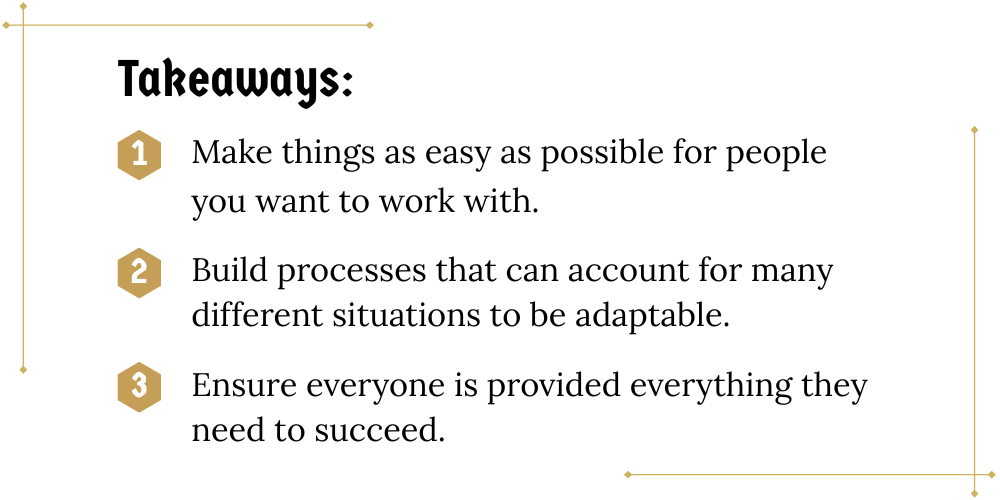
One of the biggest, and simplest, lessons from GAMA Expo was that there’s a lot of friction. Everywhere. Everyone you are trying to make partnerships with has an already established network. You are one more thing in orbit that they have to keep up with. One more account, one more password, one more tool to learn.
Try to learn how the other party operates, what tools they commonly use, what the processes they are accustomed to look like. Are there new tools that make processes more efficient gaining in popularity? What’s the response been?
Having an understanding of their workflow helps you find a way to incorporate yourself into that flow as conveniently as possible. Which, in turn, increases the likelihood that they will want to take on that extra partnership. If you aren’t sure what the answer is to any of those questions, just ask. People are more than open to talking through it with you.
This goes for players, too. When a player is getting into your game, consider the time it takes for the first time set up. How much onboarding do they need? Is there a tailored experience so that they always have a good first impression of your game. Or are you throwing them in the deep end surrounded by an army of meeples and stacks of cards? How can you best make sure that they have a good first time experiencing your product so they want to play more?
Keep in mind that you have the privilege of their time. Make their experience the best possible. Especially considering that you want repeat traffic. If they can easily interact with you and your product the first time, they will be more likely to give you their business again.
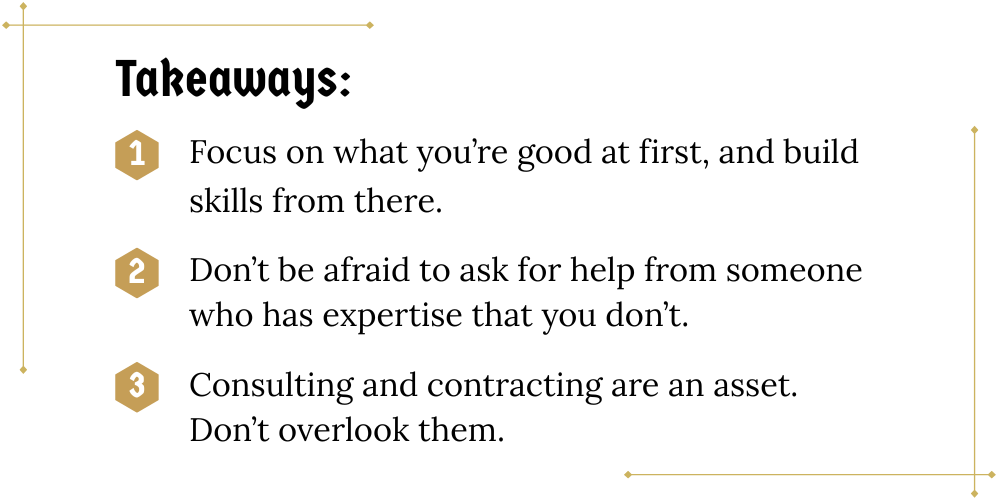
At Luminous, even with a team of six, all of us wear multiple hats, so I can only imagine the level of multitasking being done by all you skilled crafters out there. Understand that creating, whether it be designing a game, building a business, or running a crowdfunding campaign (or all of the above) is a lot of work. If you try to do it all yourself you are going to end up burnt out and might miss the mark on something.
Does a task speak to you? Does it need to be you that does it? Can you do something quickly and efficiently? Keep those hats. But if it doesn’t suit your skill set, if you can’t complete it as quickly as someone else might, consider finding help. That help can be from a friend, someone you bring on temporarily, a contractor/professional, or just bringing on a new partner. Trust me when I say your product will be so much better if those pieces that you struggle with are done by someone who finds those tasks easy.
I spent a lot of time going over the rules, doing what I can to make them the best possible, but I’m not perfect. I still had Collin to help me with the copy. And whoooo boy if we didn’t have Camri to make that guidebook look so damn good, I don’t know where we’d be right now.
You are not an island. There is a wealth of resources available to you. Just smile, say hi, ask for help, and don’t be afraid of failure. It’s just a stepping stone to success.
These are far from the only lessons I learned at GAMA Expo. However these were the notes that resonated hardest with me. If you are an aspiring designer, or someone curious about getting into the industry in one way or the other, consider becoming a GAMA member. While there are amazing perks to joining the association, there are countless intangible benefits to being part of a community greater than yourself.
There are always more people to meet, games to play, and lessons to learn.
Be the first to know about our Kickstarter launch and updates from the team.